
Guide · Chassis comparison
Ford Transit vs Mercedes Sprinter for a Composite Camper
Updated
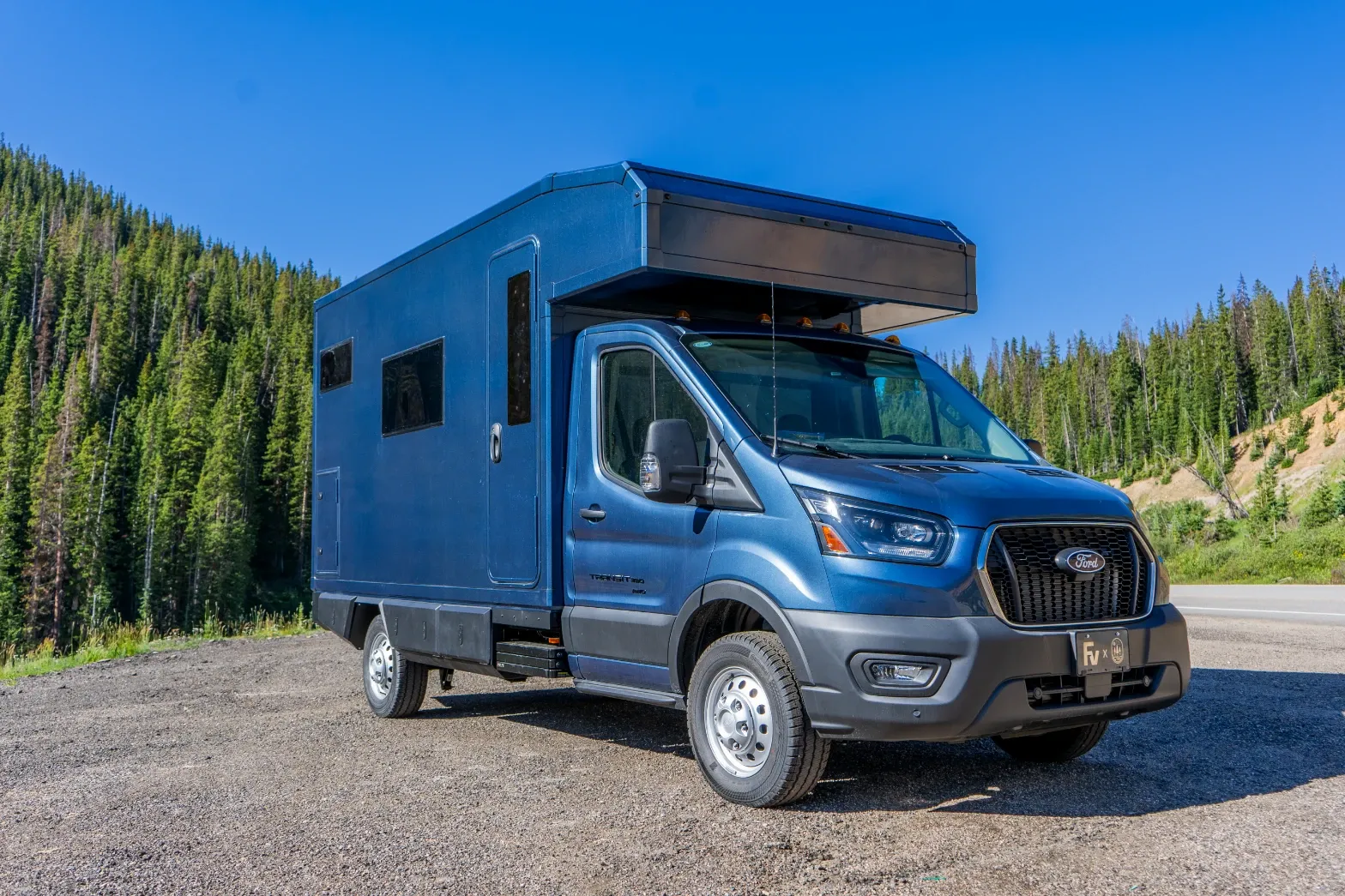
If you’re choosing between a Ford Transit and a Mercedes-Benz Sprinter for a Foundation Vehicles camper, the decision is different from the typical Transit-vs-Sprinter comparison. You’re not choosing between two cargo-van interiors. Foundation starts with the cutaway chassis and installs a purpose-built insulated composite habitat behind the cab — square walls, continuous insulation, full standing height, a cabover and a cab-to-habitat passthrough. The construction of the living body is fundamentally the same; what you’re really choosing is the chassis underneath it.
The short answer
Choose the Transit if you prefer gasoline, factory AWD, three body-length choices and a more straightforward domestic-commercial-vehicle ownership proposition. Choose the Sprinter if you specifically want the Mercedes diesel powertrain, Sprinter AWD and the Sprinter driving and cab ecosystem.
Neither is universally better.
Compare
Transit vs Sprinter at a glance
| Specification | Ford Transit | Mercedes-Benz Sprinter |
|---|---|---|
| Foundation chassis | Transit 350 / 350HD Cutaway | Sprinter 3500XD cab chassis / cutaway |
| Foundation body models | FV-138, FV-156, FV-178 | FV-144, FV-170 |
| Walkable floor | 72.5–95 sq. ft. | 73.5–95.5 sq. ft. |
| Max Foundation-listed GVWR | Up to 11,000 lb | Up to 11,030 lb |
| Fuel | Gasoline | Diesel |
| Available drivetrain | RWD / AWD | RWD / AWD |
| Current premium engine | 3.5L EcoBoost V6 | 2.0L four-cylinder turbodiesel (high-output) |
| Engine output | 300 hp / 400 lb-ft | 211 hp / 332 lb-ft |
| Foundation panel | 1.5-inch composite, R11 | 1.5-inch composite, R11 |
| Best reason to choose it | Gas simplicity + sizing flexibility | Diesel + Sprinter platform preference |
Ford currently offers Transit cutaway / chassis-cab wheelbases of 138, 156 and 178 inches with available Intelligent AWD; the current EcoBoost is rated at 300 hp and 400 lb-ft. Mercedes offers its 3500XD cab chassis in 144- and 170-inch wheelbases; the current high-output 2.0L diesel is rated at 211 hp and 332 lb-ft, with AWD configurations available on both Foundation-relevant wheelbases.
The biggest difference is the chassis, not the camper body
A conventional cargo-van comparison spends a lot of time on which van has straighter walls, which is wider near the bed, where cabinetry fits around structural ribs, and how difficult the factory sheet metal is to insulate. Most of that disappears with a Foundation body.
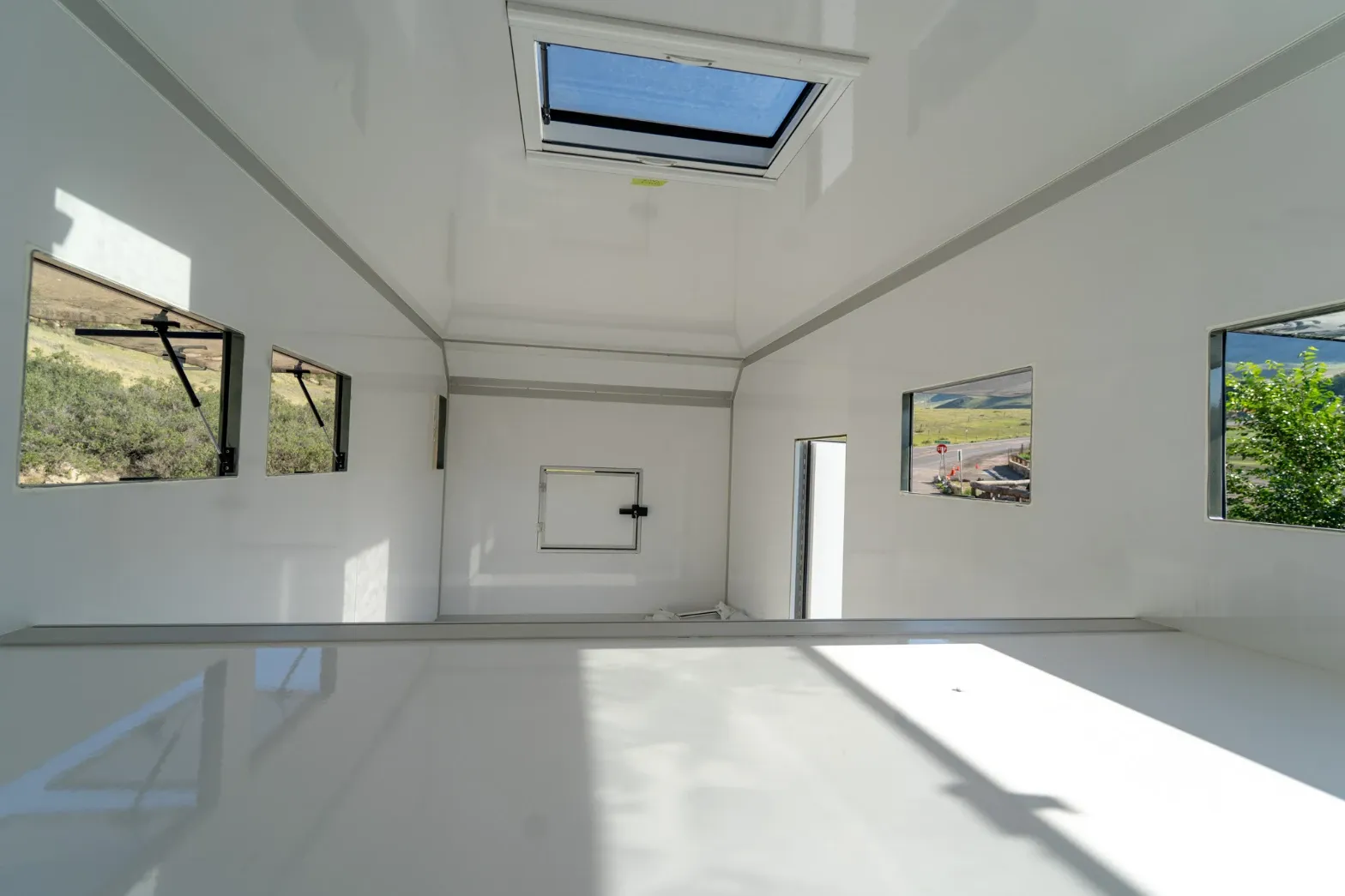
The factory cargo box isn’t the camper. The cutaway cab sits in front of a square composite habitat designed specifically to be built inside (see box van and cutaway camper bodies). That means the Transit and Sprinter both get flat walls, 90-degree interior corners, continuous insulation and a usable cabover — instead of asking an interior builder to engineer around the shape of a cargo van.
So if you’re comparing Foundation platforms, don’t choose a Sprinter because an article says its cargo walls are easier to build against. And don’t choose a Transit because somebody measured an extra fraction of an inch between the walls of a stock cargo van. Choose the chassis you want to own and drive.
Gas Transit vs diesel Sprinter
This is probably the cleanest dividing line.
The Transit is gasoline-powered. Foundation commonly pairs the platform with Ford’s 3.5L EcoBoost V6; Ford rates the current version at 300 hp and 400 lb-ft, driving through a 10-speed automatic.
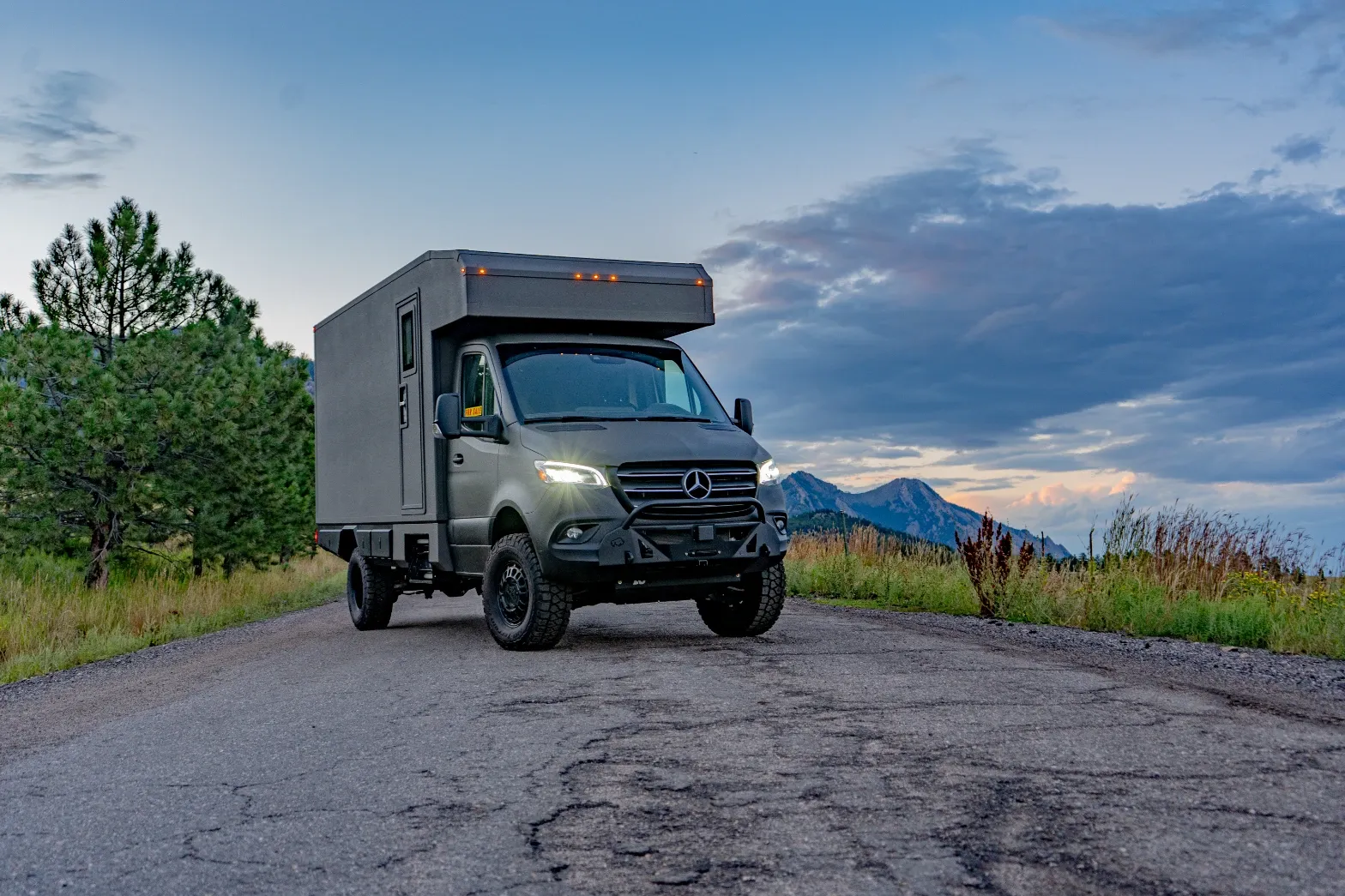
The Sprinter 3500XD uses Mercedes-Benz’s high-output 2.0L four-cylinder diesel, rated at 211 hp and 332 lb-ft through a 9G-TRONIC automatic.
Peak horsepower isn’t the reason to choose either one. The practical decision is whether you want a gasoline commercial chassis or a modern diesel commercial chassis. A Transit avoids diesel exhaust fluid and diesel-specific emissions hardware; a Sprinter gives you the operating characteristics of the Mercedes diesel powertrain that many long-distance travelers specifically want.
We wouldn’t make a blanket reliability, lifetime-cost or fuel-economy promise for either chassis. Those outcomes depend heavily on duty cycle, maintenance, loading and how the finished vehicle is used.
AWD: both are available
Both chassis can be configured with factory all-wheel drive. For most owners, that means either platform can make an excellent all-weather camper for:
- Snow and ski travel
- Forest-service roads
- Gravel
- Camp access roads
- Moderate backcountry travel
But AWD is not the same mission as a specialist-converted E-Series 4x4 with a transfer case, significant suspension changes and a heavier-duty chassis.
If low-range 4x4 and harder terrain are central to the build, the Ford E-Series belongs in the conversation too.
Transit gives you one particularly useful middle size
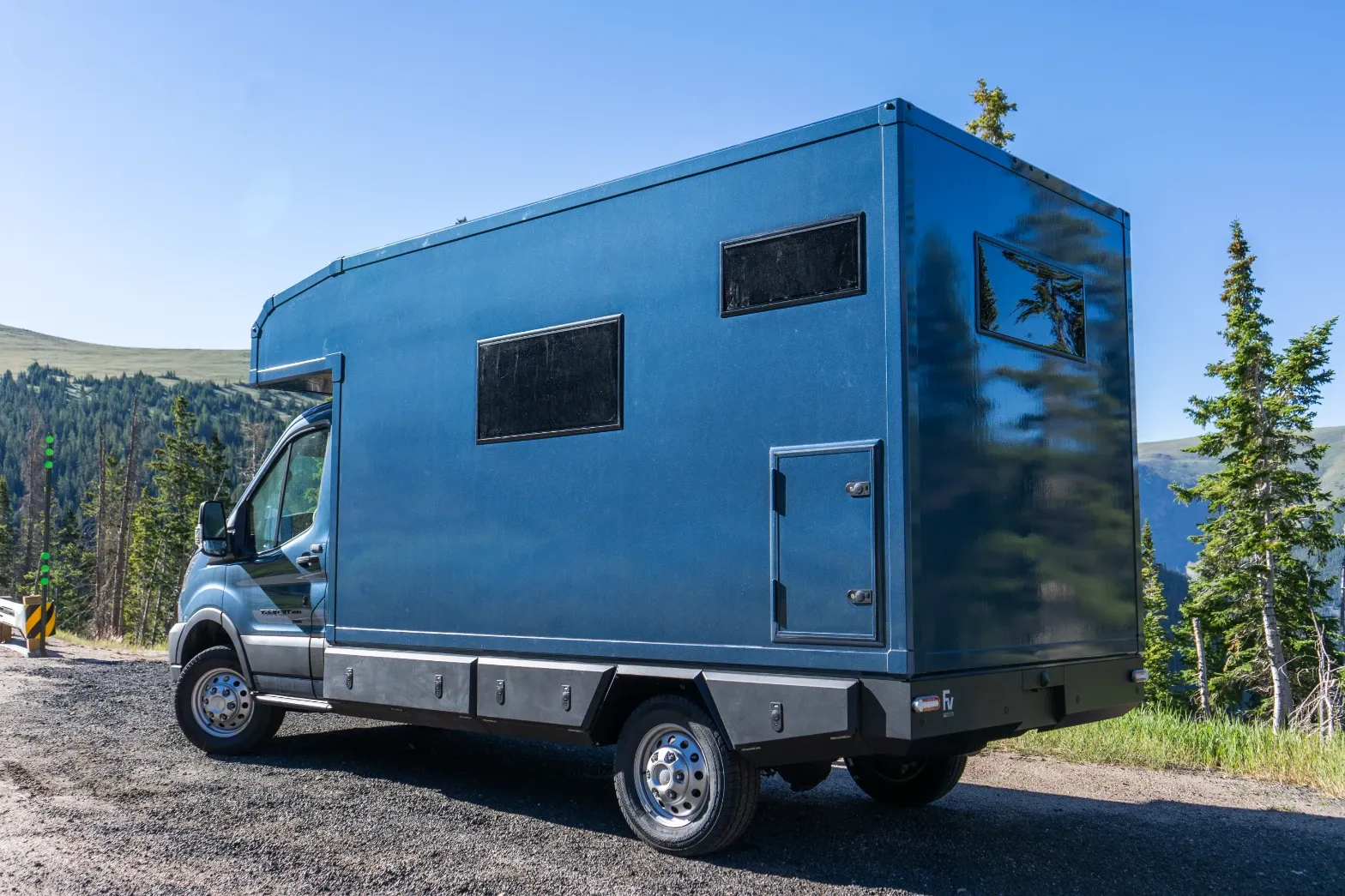
Foundation currently offers three Transit bodies:
- FV-138 — 72.5 sq. ft. of walkable floor
- FV-156 — 82 sq. ft.
- FV-178 — 95 sq. ft.
The Sprinter lineup has two: the FV-144 (73.5 sq. ft.) and the FV-170 (95.5 sq. ft.).
At the small end, they’re close. At the large end, they’re also close.
The useful difference is the Transit FV-156 in the middle — it gives a buyer who wants more room than the compact body an 82-square-foot option without stepping immediately to a 95-square-foot habitat. That can matter more to the finished vehicle than a lot of brand-level differences between Ford and Mercedes.
Which has more camper space?
At comparable ends of the range, essentially neither has a decisive advantage. The compact Foundation bodies provide roughly 73 square feet of walkable floor; the largest Transit and Sprinter options both provide about 95 square feet.
Because Foundation supplies the camper body rather than relying on the factory cargo shell, the Sprinter doesn’t automatically get a “better camper interior,” and the Transit doesn’t automatically get a “wider camper interior.” The layout opportunity comes primarily from the Foundation body size you select.
What about payload?
Again, compare the actual configuration — not the badge. Foundation’s Transit models run up to 11,000-lb GVWR; the FV-170 Sprinter is listed at up to 11,030 lb. But GVWR alone is not payload.
The finished camper has to account for:
- Chassis curb weight
- Foundation body and subframe
- Interior
- Passengers
- Fresh and waste water
- Batteries
- Solar and electrical equipment
- Fuel
- Bikes or motorcycles
- Recovery equipment
- Food and personal gear
That’s why we prefer doing the weight discussion around a specific chassis and intended build rather than publishing one generic “payload” number.
Which one should you choose?
Choose the Ford Transit if:
- You want a gasoline drivetrain.
- You want factory AWD without moving to a heavier 4x4 platform.
- You like having three Foundation body lengths instead of two.
- The FV-156’s intermediate size fits your layout particularly well.
- You want a strong general-purpose platform for a mix of highway, weather and moderate backcountry use.
Choose the Mercedes-Benz Sprinter if:
- You specifically want a diesel.
- You prefer the Sprinter cab and driving environment.
- You already know you want the 144- or 170-inch Mercedes chassis architecture.
- The Sprinter aftermarket and Mercedes-specific ownership ecosystem are important to you.
- You simply prefer the Sprinter as the chassis beneath the camper.
So, is the Transit or Sprinter better?
For a conventional cargo-van conversion, the differences in the factory van body matter enormously. For a Foundation build, they matter much less.
The same basic composite-body architecture solves the camper-space problem on both. The better chassis is the one whose drivetrain, wheelbase and ownership characteristics fit your use.
If we had to simplify the choice:
- Transit — gas, AWD, three sizes, highly versatile.
- Sprinter — diesel, AWD, two established chassis sizes, Mercedes platform.
And if your answer to the terrain question is “I want more than AWD,” compare both of them with the Ford E-Series 4x4.
Common questions
Questions people ask
Is the Transit or Sprinter better for a camper?
Neither universally. With a Foundation composite body, the biggest differences are the chassis drivetrain and available body sizes rather than the shape of the original van body.
Which has more living space?
Foundation’s largest Transit has approximately 95 sq. ft. of walkable floor and the largest Sprinter approximately 95.5 sq. ft. The compact versions are also very close.
Are both available with AWD?
Yes. Both Transit and Sprinter have factory AWD configurations relevant to Foundation platforms.
Why start with a cutaway instead of a cargo van?
A cutaway lets Foundation install a purpose-built square, insulated composite habitat instead of building an interior around the curved sheet-metal structure of a cargo van.
What if I want true low-range 4x4?
Look at the Ford E-Series with a specialist 4x4 conversion.
Compare the platforms
Platforms discussed in this guide
The Foundation body is the same on either cutaway — so compare the chassis directly.
Related